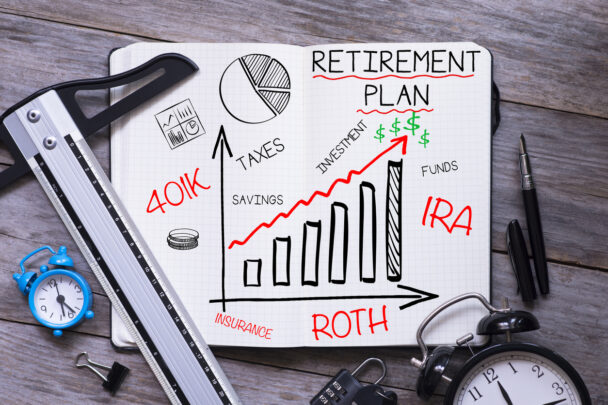
The Roth IRA/Roth 401k is one of the best ways to accumulate and preserve wealth, but perhaps the least understood. A Roth, funded by after-tax contributions, has many appealing attributes, including tax-free growth and tax/penalty-free withdrawals if over the age of 59½, and the withdrawals are at least five years after your first contribution to any Roth you own.
Additionally, Roth’s are not subject to Required Minimum Distributions (RMDs) like Traditional IRAs. (Note: While earned income is required to make contributions to a Roth, earners may make contributions for their spouses who have little to no earned income if filing a joint tax return). See below for ways to contribute to a Roth and take advantage of this great investment vehicle:
Ways to Contribute:
Direct Contribution: For 2021 the contribution limit is $6,000 with a $1,000 catch up for a total of $7,000 for those over the age of 50. (Note: Phaseouts begin for Single tax filers with Modified Adjusted Gross Income (MAGI) of $125,000-$140,000; For Married Filing Jointly from $198,000-$208,000). Schwab provides a 2020-2021 Roth IRA Contribution Limits that makes it easier to understand.
Backdoor Roth Strategy: This strategy allows you to avoid the income limits associated with a Direct Contribution to a Roth. The first step is to make your contribution to a Traditional “Non-Deductible” IRA first. The same contribution limits associated with a Direct Contribution apply, but there are no income limits for this, so everyone with earned income (plus non-working spouses of spouses with income) qualifies. Next, execute a Roth Conversion. There are no income limits for a Roth conversion, and because you only pay tax on the earnings when withdrawing from Non-Deductible IRA’s (There are no earnings in this case!), you will pay no tax. (Note: When executing a Roth Conversion, you must pro-rate the Traditional “Non-Deductible” IRA money with any Traditional “Deductible” IRA money you have for income tax purposes, and the portion related to the Traditional Deductible IRA must be reported for income tax purposes. For this reason, it may not make sense to execute this strategy if Traditional IRA assets exist). Additional information on this strategy can be found in our recent column, Secret Roth IRA Strategy.
Roth Conversion: The Roth Conversion strategy involves voluntarily paying taxes early to convert money from a Traditional “Deductible” IRA to a Roth IRA. The intent of the strategy is to pay taxes now in a lower tax bracket and transfer money to the tax-free environment of a Roth IRA to avoid potentially more significant taxes in the future.
Company 401k: Some employers offer a Roth 401k option in addition to a Traditional 401k option. The same 2021 deferral limits of $19,500 for those under age 50 and $26,000 for those over the age of 50 apply but contributions are made with after-tax income. In addition, some company plans allow for what is called a “Mega Backdoor Roth” Click on the link for more details!
**Note: Please consult your financial advisor, or tax professional before executing any of the above strategies to ensure they fit with your specific case facts**
For weekly insights, follow The Welch Group every Tuesday morning on WBRC Fox 6 for the money Tuesday segment.